
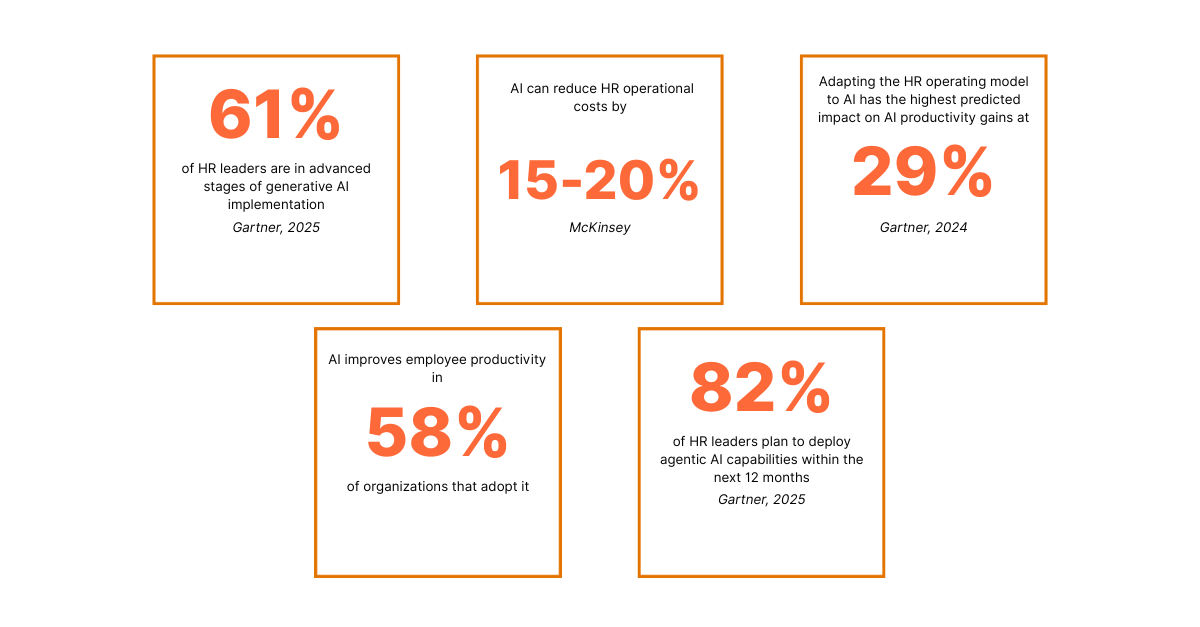
Artificial intelligence is no longer a distant promise for HR leaders it’s already reshaping how organizations recruit, onboard, manage, and retain people. The best HR software and HRMS platforms are now built with AI at their core, automating the repetitive work that once consumed HR teams’ most productive hours. According to Gartner, 61% of HR leaders were already in advanced stages of implementing generative AI as of January 2025, a dramatic rise from just 19% in 2023. Put simply: AI in HR has moved from pilot projects to business-critical infrastructure.
For HR managers, CHROs, and HR tech decision-makers evaluating all-in-one HRMS or HR management software, understanding where AI delivers the most value and where the real risks lie is now a strategic priority. This article examines the five most impactful ways AI is transforming HR, the challenges teams must navigate, and how to build a practical roadmap for AI adoption.
The State of AI in HR: Why Now?
The pressure on HR functions has never been greater. organizations are managing more distributed workforces, tightening compliance requirements, and being asked to do more with leaner teams. At the same time, the volume and complexity of HR data from recruitment pipelines to performance reviews to leave management have outgrown manual processes.
The result is a fundamental shift in what HR management software must deliver. HRMS software is evolving from a digital filing cabinet into an intelligent platform that learns, predicts, and acts on workforce data in real time.
According to Gartner’s 2024 Productivity Impact of AI Survey, the single biggest lever for realising AI’s productivity potential in HR is not buying new tools but evolving the HR operating model itself. This shift, which includes redesigning workflows and redefining how HR teams work alongside AI, accounts for 29% of predicted productivity gains. CHROs who grasp this distinction will lead the transformation. Those who treat AI as a bolt-on upgrade will fall behind.
5 Powerful Ways AI Is Transforming HR in 2026
Smarter Recruitment and Talent Acquisition
Recruiting is often the first place organizations deploy AI-powered HR tools, and the results are compelling. Consider a growing logistics company with around 300 employees. Their HR team was spending roughly 60% of its working week on administrative screening tasks, reviewing applications, scheduling interviews, and sending follow-up emails. After deploying an AI-assisted recruiting module within their HRMS software, the time dropped significantly. The system automated resume screening, flagged top candidates against predefined criteria, and triggered interview scheduling workflows automatically.
AI recruiting tools can now process thousands of data points per candidate, identifying experience, skills alignment, and culture indicators far faster than a manual review. According to LinkedIn’s Future of Recruiting research, 58% of recruiters say AI reduces administrative busywork, freeing them to focus on higher-value candidate relationship building. For HR teams evaluating the best HR software options, AI-driven recruitment capabilities are now a non-negotiable feature of any competitive HR system.
Tradeoff - AI recruitment tools can unintentionally reinforce biases present in historical hiring data. HR teams must audit training data regularly and apply human oversight at decision-making stages to remain compliant with frameworks such as GDPR and emerging AI regulations like the EU AI Act, which classifies AI used in employment as high-risk.
AI-Driven Employee Onboarding
Onboarding is a critical window for employee engagement, yet it remains one of the most manually intensive processes in HR. Personalised onboarding at scale was simply not feasible before AI-powered HR tools could automate document workflows, generate task checklists tailored to roles, and answer new hire questions through intelligent HR chatbots.
Imagine an HR team managing onboarding for 50 new hires per quarter across three countries. Previously, an HR coordinator would manually configure each onboarding pack, track compliance document submissions, and field repetitive queries about policies and benefits. With AI-enabled HRMS software, that process becomes largely self-managing: checklists are auto-generated by role, reminders are triggered automatically, and a conversational AI assistant handles routine new hire questions around the clock.
Predictive Workforce Analytics and HR Planning
One of the most transformative applications of AI in HR is the shift from reactive to predictive workforce management. Traditional HR planning relied on lagging indicators, analysing why employees left after the fact, or identifying skills gaps only when a project was already at risk. Predictive HR analytics changes this dynamic entirely.
Using machine learning in HR, modern HR systems can now identify employees who exhibit early indicators of disengagement, model future workforce capacity based on growth scenarios, and surface skills gaps before they affect business performance. For a mid-sized manufacturing company with 500 employees operating across multiple sites, this capability can mean the difference between proactive retention and a costly wave of unexpected turnover.
According to McKinsey, AI can reduce HR operational costs by 15–20% by surfacing the underlying drivers of employee attraction, turnover, and performance and suggesting targeted interventions. For organizations evaluating the best HRMS or top-rated HR software, robust workforce analytics should be a core evaluation criterion.
Tradeoff - Predictive analytics is only as accurate as the data that powers it. Incomplete or inconsistent HR data will produce unreliable predictions. Before deploying people analytics at scale, organizations must invest in data governance and quality standards to ensure meaningful, trustworthy outputs.
Intelligent Performance Management
Annual performance reviews are being replaced by continuous, AI-assisted performance management processes. Rather than relying on manager recall and subjective assessments once a year, AI-powered performance management platforms collect real-time feedback signals, track goal progress, and generate data-driven insights that support fairer, more accurate reviews.
Consider a professional services firm where managers oversee distributed teams across time zones. An AI-enabled performance management system within their HR management software continuously aggregates feedback from peers, project completion data, and goal metrics. By the time a formal review cycle occurs, the HR team has a rich, objective picture of each employee’s contribution, dramatically reducing recency bias and the burden on individual managers.
According to Deloitte research, 65% of HR professionals believe AI makes performance reviews more efficient by reducing manual data collection. More importantly, consistent AI-facilitated feedback correlates with higher employee engagement, a key driver of retention.
AI-Powered Leave and Workforce Scheduling
Leave management may seem like an administrative function, but inaccurate or inefficient leave management has direct consequences for compliance, payroll accuracy, and workforce planning. The best leave management software now incorporates AI to forecast leave patterns, flag potential compliance issues under local labour law frameworks, and automatically balance workforce coverage needs.
For a retail company with 200 employees operating on rotating shifts, AI-powered leave management means the system can predict high-absence periods based on historical patterns, recommend proactive staffing adjustments, and ensure leave requests are processed in line with FLSA, GDPR, or relevant local regulations without requiring manual oversight at every step.
This is where an all-in-one HR software like OrangeHRM delivers particular value: integrating leave management, attendance tracking, and workforce scheduling within a single AI-enhanced platform eliminates the data silos that create compliance exposure and operational inefficiency.
Traditional HR vs. AI-Assisted HR: A Practical Comparison
|
HR Function |
Traditional Approach |
AI-Assisted Approach |
|
Recruitment |
Manual CV screening, high time-to-hire |
Automated screening, predictive candidate ranking |
|
Onboarding |
Generic checklists, manual document collection |
Personalised workflows, chatbot-led query resolution |
|
Performance Management |
Annual reviews, subjective manager recall |
Continuous feedback, real-time goal tracking |
|
Workforce Planning |
Reactive, based on lagging data |
Predictive analytics, proactive capacity modelling |
|
Leave Management |
Manual approvals, spreadsheet tracking |
AI-forecast scheduling, automated compliance checks |
Challenges and Tradeoffs: What HR Teams Need to Know
Deploying AI in HR is not without significant challenges. Understanding these risks upfront is what separates successful implementations from costly failed experiments.
Data Quality and Readiness
AI models are only as reliable as the data they learn from. Organizations with fragmented or inconsistent HR data spread across legacy systems, spreadsheets, and disconnected platforms will struggle to realize AI’s promise. A data readiness audit is a necessary first step before any AI implementation.
Change Management and Workforce Adoption
Gartner research indicates that the root cause of poor AI adoption in organizations is rarely employee resistance it is rushed implementation without adequate workforce preparation. HR must lead AI change management from the front: communicating clearly about what AI will and will not do, involving employees in pilot programmes, and investing in upskilling. According to Gartner, 37% of employees choose not to use AI tools simply because their colleagues are not using them, a social adoption dynamic that HR is uniquely positioned to address.
Bias and Ethical Risk
Algorithmic bias in recruitment and performance management remains a documented risk. HR teams implementing AI-powered HR tools must establish clear audit cycles, maintain human oversight at all consequential decision points, and ensure their chosen vendor adheres to responsible AI principles. Data privacy compliance under GDPR and similar frameworks must be validated before deployment.
Vendor Capability vs. Marketing Claims
The HR technology market is crowded with vendors making ambitious AI claims. When evaluating HR management software, HR leaders should ask for specific evidence of AI outcomes, not just feature lists. Request use cases from organizations similar to yours in size, industry, and complexity.
How to Build an AI-Ready HR Operating Model: 5 Steps
The Gartner 2024 Productivity Impact of AI Survey is clear: the highest predictor of AI-related productivity gains in HR is not the technology itself, but the evolution of the HR operating model. Here is a practical roadmap for getting started.
-
Conduct a Workflow Audit - Map your current HR processes and identify which tasks are high-volume, rule-based, and time-consuming. These are your best automation candidates.
-
Assess Your Data Foundation - Before deploying AI tools, evaluate the completeness and consistency of your existing HR data. Identify gaps and create a data governance plan.
-
Define Your AI Strategy with the C-Suite - CHROs should position AI as a workforce issue, not just a technology project. Secure executive alignment on objectives, governance, and success metrics before implementation.
-
Pilot with High-Impact, Lower-Risk Use Cases - Begin with areas like leave management automation or recruitment screening where outcomes are measurable and human oversight is straightforward. Build confidence before expanding.
-
Invest in Upskilling and Change Management - Identify employees who are digitally curious and include them in pilot programmes. Transparent communication about AI’s role will accelerate adoption and reduce resistance.
Conclusion: Lead the AI Transformation or Be Left Behind
AI is not coming for HR, it is already here, and the organizations that are building their AI strategy now are gaining a measurable competitive advantage. From smarter recruitment to predictive workforce planning, the best HR software platforms are delivering capabilities that were unimaginable just three years ago.
But technology alone is not the answer. As Gartner’s research makes clear, the highest-impact investment an HR leader can make is in evolving the HR operating model itself: redesigning workflows, building AI literacy across the HR function, and positioning HR as the strategic driver of the organisation’s AI agenda. CHROs who act on this now, rather than waiting for perfect conditions, will define the future of work inside their organizations.
The practical path forward starts with a clear-eyed assessment of where your HR process stands today, a prioritised roadmap for AI adoption, and a technology partner whose platform is built for this moment. Ready to see AI-powered HR in action? Book a FREE demo today and discover how an intelligent, all-in-one HR management software can transform your HR processes.