
Ask any HR manager at a company with employees in more than two countries what keeps them up at night, and leave compliance will almost certainly come up. Not because leave management is complicated in isolation but because it is complicated everywhere, and everywhere is different. The EU mandates a minimum of four weeks of paid annual leave. Brazil requires 30 days. Japan’s statutory system links entitlement to length of service. The UAE aligns leave rules with religious observance calendars. Managing all of that in a single system, consistently and correctly, is not a minor administrative task. It is a significant compliance risk.
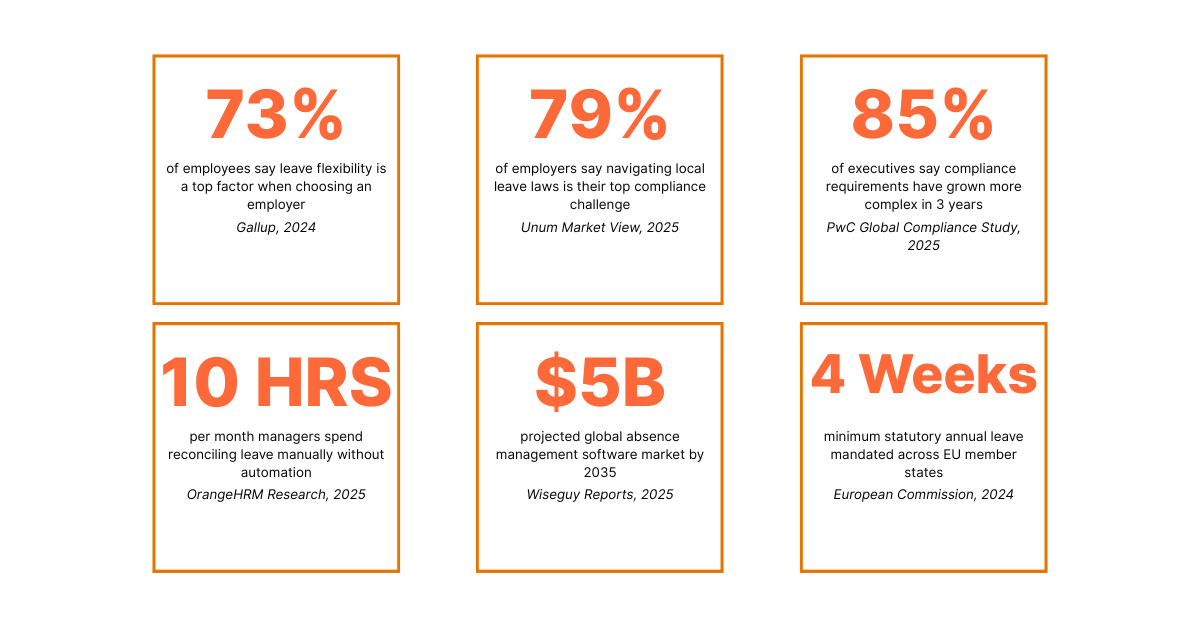
According to PwC’s 2025 Global Compliance Study, 85% of executives report that compliance requirements have grown more complex over the last three years. For HR teams managing leave across multiple jurisdictions, that complexity is felt most acutely at the intersection of local labour law, company policy, and the limits of the software they are using. Most HRMS platforms were designed for a single-country context, then adapted for global use. The result is workarounds: spreadsheets sitting alongside the system, manual calculations, and policy inconsistencies that accumulate over time into real legal and financial exposure.
OrangeHRM was built differently. Its Leave Rule Engine, one of the most configurable in the HR software market, allows organisations to define, automate, and apply leave policies across any number of countries from a single platform. This article examines why that matters, what the engine can actually do, and how multinational organisations are using it to turn leave management from a compliance headache into a competitive advantage.
The Global Leave Compliance Landscape in 2025
Leave management has always been a core HR function. What has changed dramatically in the last decade is its complexity. Three converging forces have made what was once a relatively straightforward administrative task into one of the most technically demanding areas of HR operations.
The Globalisation of the Workforce
Organisations that once operated in a single country now employ people across multiple jurisdictions, often without a proportional increase in HR headcount. A manufacturing business that began in Germany and expanded to Poland, Mexico, and Vietnam now operates under four entirely different statutory leave regimes, each with its own leave accrual methods, carry forward rules, public holiday calendars, and documentation requirements. Managing that complexity through a single, coherent system is no longer optional, it is a legal and operational necessity.
The Unum Market View (2025) confirmed that navigating state and local leave laws was the top compliance challenge for employers, cited by 79% of respondents. For multinational organisations, that challenge is compounded across every country of operation.
Increasing Regulatory Scrutiny
Labour regulators are becoming more active, not less. The consequences of non-compliance range from administrative penalties to litigation, reputational damage, and in some jurisdictions, criminal liability for company officers. In the UK, for example, failure to correctly apply statutory leave entitlements can result in Employment Tribunal claims and fines of up to £20,000 per affected employee. In the EU, the Working Time Directive sets binding minimum standards that member states are required to enforce. In Australia, the Fair Work Act prescribes mandatory leave entitlements with strict carry forward rules that employers cannot contract out of.
Against this backdrop, relying on manual processes or a system that was not designed to handle multi-country configurations is not just inefficient, it is a measurable financial risk.
Shifting Employee Expectations
Gallup’s 2024 research found that 73% of employees now cite leave flexibility as a top factor when choosing an employer. The range of leave types employees expect has expanded significantly: mental health leave, wellness days, study leave, parental leave beyond statutory minimums, bereavement leave for extended family, and in some sectors, volunteering leave or sabbatical programmes. Organisations that cannot configure and administer these leave types cleanly within their HRMS are forced to manage exceptions outside the system, which is where errors accumulate.
What Is a Leave Rule Engine and Why Does It Matter?
The term ‘leave rule engine’ refers to the core configuration layer within an HRMS leave module that defines how leave works: how it is accrued, how entitlements are calculated, what can be carried forward to the next period, when it expires, who it applies to, and what restrictions govern when it can be taken. It is, in essence, the logic layer that translates company policy and statutory requirements into automated, consistent behaviour. In less sophisticated HRMS platforms, this engine is shallow: you can set a number of days, assign them to employees, and track what is taken. The complexity stops there. In OrangeHRM, the Leave Rule Engine is deep: it supports multiple leave periods, country-specific configurations, tenure-based accruals, complex carry forward logic, short-term validity windows, and a full public holiday framework, all configurable at the leave-type level, not just the organisation level.
The practical difference is significant. Consider a scenario involving a regional professional services firm with 800 employees across eight countries. Their annual leave policy varies by country, seniority level, and employee type. In three countries, unused leave can be carried forward; in two, it expires at year-end; in one, a partial carry forward applies up to a maximum of five days. Without a configurable leave rule engine, managing this requires manual calculation and a team of people tracking exceptions. With OrangeHRM’s Leave Rule Engine, each configuration is set once, then applied automatically, consistently and without administrative overhead.
Inside the OrangeHRM Leave Rule Engine: Key Capabilities
The following sections examine the core components of OrangeHRM’s Leave Rule Engine, what each capability does, and why it matters for HR teams managing leave at scale.
Country-Based Leave Configurations
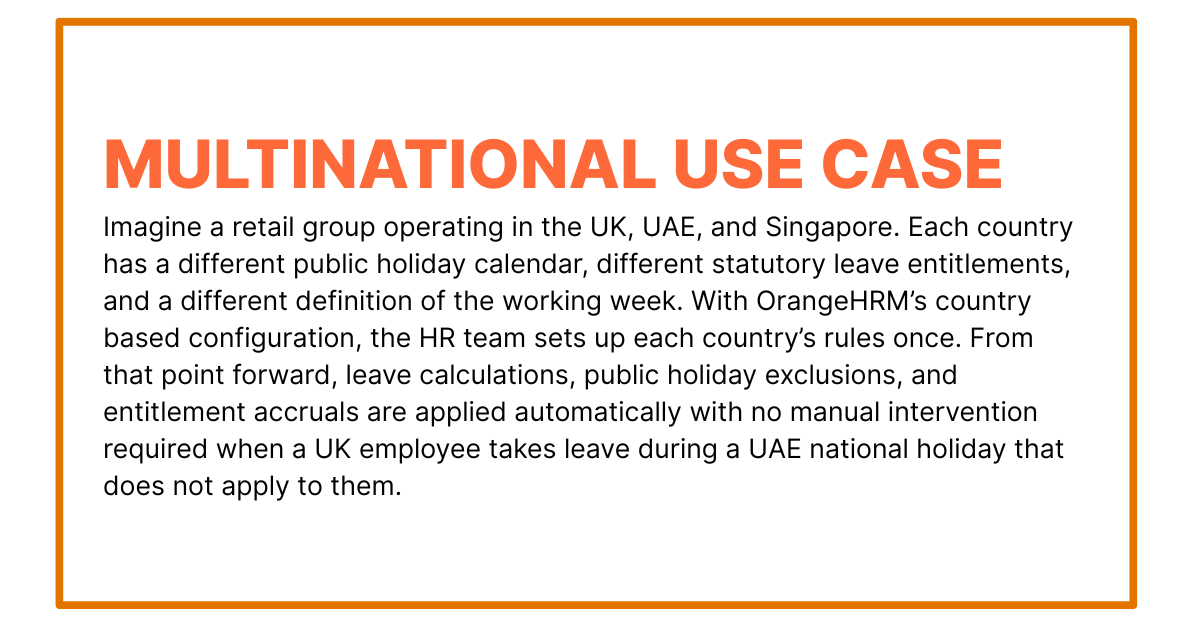
OrangeHRM’s Leave Rule Engine supports country-specific configuration as a native capability, not a bolt-on. This means HR administrators can define different leave rules for different countries within the same platform, without needing separate instances or parallel systems. For many multinational organisations, this alone eliminates the need for a separate country-level spreadsheet or secondary tool.
Statutory leave entitlements can be pre-configured per country and applied automatically to employees based on their assigned location. Public holiday calendars are configurable at the country level, with the option to mark holidays as repeating annually, eliminating the need for manual updates each year. Work week definitions (which days are working days) are also set per country, ensuring accurate leave day calculations for employees in jurisdictions with different working patterns.
Three Leave Entitlement Types
OrangeHRM supports three distinct entitlement mechanisms, each serving a different organisational policy need:
|
Entitlement Type |
How It Works |
Best Used For |
|
Added Entitlement |
HR administrator or authorised user manually grants a specific number of leave days to an employee or group |
One-off adjustments, special grants, or non-recurring leave awards |
|
Accrued Entitlement |
The system automatically credits leave days to employees on a defined schedule (monthly, on hire date anniversary, etc.) as per the configured accrual rules |
Annual leave, PTO, or any leave type that builds up over time based on service |
|
Brought Forward Entitlement |
Unused leave from the current leave period is automatically carried into the next period based on the carry forward rules configured in the leave rule |
Jurisdictions or policies that permit rollover of unused entitlement, subject to caps or expiry dates |
Source: OrangeHRM, 2025.
Configurable Accrual Rules
Accrual rules define how leave entitlement accumulates over time. OrangeHRM’s accrual configuration is granular enough to accommodate the range of accrual methods found across global statutory frameworks and company policies.
-
Frequency - Leave can accrue on a monthly, yearly, or hire-date-anniversary basis, depending on how the leave period is defined.
-
Day of Crediting - HR administrators can specify whether accrual credits fall on the first day of the month, the last day of the month, the employee’s hire date, or the hire date’s monthly anniversary.
-
Tiered Accrual - Rules can be configured to increase accrual rates based on tenure, allowing organisations to reward long-serving employees with more generous leave accrual, a common feature of EU and APAC statutory frameworks.
-
Pro-Ration - For employees joining mid-period, entitlements are automatically pro-rated based on the applicable rule, removing the need for manual calculations at onboarding.
Carry Forward and Expiry Rules
One of the most common sources of leave management errors, and one of the most frequently litigated areas of employment law, is the handling of unused leave at the end of a leave period. OrangeHRM’s carry forward rules allow administrators to configure exactly how unused entitlement is handled.
-
Unlimited Carry Forward - All unused leave rolls over to the next period without restriction.
-
Capped Carry Forward - Only a defined number of days (e.g., a maximum of five) can be carried forward; the remainder is forfeited.
-
Expiry Based Carry Forward - Carried-forward days are valid for a defined period (e.g., must be taken within the first quarter of the following year) before expiring automatically.
-
No Carry Forward - All unused leave expires at the end of the leave period with no rollover, consistent with ‘use it or lose it’ policies in jurisdictions that permit them.
The system applies whichever rule is configured automatically at the end of the leave period, removing the need for HR teams to manually audit and adjust balances, a task that, according to OrangeHRM’s own research, consumes up to ten hours per manager per month when handled manually.
Short-Term Leave Entitlement (STLE)
A capability that is less common but increasingly important is short-term leave entitlement: leave types that are valid for a defined short window (typically two to three months) rather than the full leave year. OrangeHRM supports STLE natively, which is particularly relevant for organisations managing emergency leave, in-lieu leave, or compassionate leave policies that have a defined expiry window.
Consider an HR team at a healthcare organisation that grants compensatory leave for employees who worked on a public holiday. That comp leave is only valid for 60 days; after that, it expires. Without STLE configuration, tracking this requires manual monitoring. With OrangeHRM, the validity window is set in the leave rule and the system manages expiry automatically.
Custom Leave Types
Beyond statutory leave, organisations increasingly offer a range of voluntary or company-specific leave types: study leave, wellness days, volunteer days, extended parental leave, and others. OrangeHRM allows HR administrators to create fully custom leave types, each with its own rule configuration, entitlement method, accrual schedule, carry forward rules, and approval workflow, independently of any other leave type in the system.
Bradford Factor Threshold
For organisations that monitor absence patterns, OrangeHRM includes Bradford Factor functionality. The Bradford Factor is a widely used absence management formula that weights frequent short absences more heavily than longer continuous absences, reflecting their disproportionate impact on team productivity and scheduling. HR administrators can configure threshold levels within OrangeHRM, allowing the system to flag employees whose absence patterns cross defined thresholds for review.
OrangeHRM Leave Rule Engine: Feature Overview
|
Country-Based Rules Apply different statutory configurations per country from a single platform instance. |
Accrual Automation Define frequency, day of credit, and tenure-based tiering for automatic entitlement accrual. |
|
Carry Forward Controls Configure unlimited, capped, expiry-based, or no carry forward per leave type. |
Short-Term Leave Entitlement Set validity windows (e.g. 60 days) for comp leave, emergency leave, or in-lieu leave. |
|
Public Holiday Calendars Country-specific holiday calendars with annual repeat, fully integrated with leave calculations. |
Custom Leave Types Create wellness days, study leave, volunteer leave, each with independent rule configuration. |
|
Three Entitlement Methods Added, accrued, and brought-forward entitlements covering every policy scenario. |
Bradford Factor Threshold Monitor and flag absence frequency patterns against configurable thresholds. |
|
Self-Service & Mobile Employees and managers access leave on any device via OrangeHRM’s mobile app. |
Payroll Integration Leave data feeds directly into payroll to ensure accurate calculation of paid absence. |
Why the Leave Rule Engine Is a Strategic Asset for Multinational Companies
For organisations operating in a single country, a well-configured leave rule engine is a significant operational improvement. For multinational companies, it is something more: it is a critical compliance infrastructure component.
Centralised Control, Local Precision
The core advantage of OrangeHRM’s approach is that it provides centralised oversight without sacrificing local accuracy. A global HR team can view all leave activity across every entity from a single dashboard, while the underlying rules in each country reflect the specific statutory requirements and company policies applicable there.
For a growing technology company with engineering teams in India, customer success teams in the Philippines, and operations leadership in the Netherlands, this means a single HRMS that does not require country-specific workarounds. The Indian team’s casual leave, earned leave, and sick leave framework is configured correctly. The Dutch team’s statutory minimum of 20 days (four times the weekly working hours) is applied automatically. The Philippines team’s service incentive leave entitlement under the Labour Code is set up independently. All of it runs in one system, with one source of truth for HR reporting.
Reducing Compliance Exposure
Non-compliance with leave law is not a theoretical risk. UK employment tribunals regularly award compensation to employees whose statutory leave entitlements were not correctly applied, and the cumulative exposure for organisations with large workforces can be substantial. In France, failure to comply with the RTT (reduction of working time) rules can trigger back-payment obligations across entire employee cohorts.
Automated, rules-based leave management eliminates the most common source of these errors: human miscalculation. When the system calculates entitlements, accruals, and carry forwards based on explicitly configured rules, rather than manual intervention, the risk of error drops significantly, and the audit trail for any calculation is complete and accessible.
Supporting Employee Experience at Scale
Gallup’s finding that 73% of employees cite leave flexibility as a top employer-choice factor underlines the talent dimension of leave management. Organisations that can offer rich, varied leave policies, and administer them accurately and transparently, have a genuine competitive advantage in talent retention. OrangeHRM’s employee self-service functionality allows employees to view their entitlements, check balances in real time, submit requests, and track approval status on any device, including through the OrangeHRM mobile app.
Transparency reduces HR’s administrative burden as well. When employees can check their own leave balance without contacting HR, the volume of ad hoc queries the team handles drops meaningfully, freeing bandwidth for higher-value work.
Traditional Leave Management vs. OrangeHRM’s Leave Rule Engine
|
Scenario |
Traditional / Manual Approach |
OrangeHRM Leave Rule Engine |
|
Multi-country entitlements |
Separate spreadsheets or systems per country; high risk of inconsistency |
Single platform with country-specific rule sets configured independently |
|
Accrual calculation |
Manually calculated at period end; error-prone at scale |
Automated accrual on defined schedule; real-time balance updates |
|
carry forward at year-end |
Manual audit of each employee’s balance; adjustments made by HR |
Rules-based automatic carry forward, cap, or expiry applied by the system |
|
Public holidays |
HR team updates holiday calendars manually each year, per country |
Country calendars configured once with annual repeat; no annual maintenance required |
|
Comp / in-lieu leave |
Tracked separately; expiry dates monitored manually |
Short-Term Leave Entitlement with configurable validity window; auto-expiry |
|
New employee pro-ration |
HR manually calculates partial entitlement at onboarding |
Automatic pro-ration based on the applicable leave rule |
|
Absence pattern monitoring |
Manager discretion; no systematic flagging |
Bradford Factor threshold configured; system flags patterns for HR review |
|
Employee leave enquiries |
Employees contact HR to check balances or status |
Self-service access via web and mobile app; real-time visibility |
|
Payroll accuracy |
Manual handoff of leave data to payroll; frequent reconciliation errors |
Leave data integrates directly with payroll; automatic deduction calculation |
|
Compliance audit trail |
Documents stored in separate systems; hard to produce on request |
Full record of entitlements, transactions, and approvals held in one system |
Challenges and Considerations When Configuring a Leave Rule Engine
The case for a sophisticated, configurable leave rule engine is clear. But implementing one successfully requires more than purchasing software. HR teams should plan for the following challenges at the outset.
Challenge 1: Policy Clarity Before Configuration
A leave rule engine can only automate what has been defined. Organisations that have operated with informal or inconsistent leave policies across their countries will need to formalise those policies before configuration begins. This is not a software limitation it is an opportunity. The implementation process often surfaces policy inconsistencies that have been creating legal risk for years.
Challenge 2: Data Migration for Existing Balances
Organisations moving from manual systems or a legacy HRMS will need to migrate existing leave balances accurately. This requires a reconciliation exercise to validate that employee balances are correct before they are entered into the new system. Rushing this step is the most common cause of post-implementation discrepancies.
Challenge 3: Change Management for Managers and Employees
Moving from informal to automated leave management changes the experience for both managers and employees. Managers who were accustomed to handling leave requests via email or informally will need to adopt the approval workflow within the system. Employees will need to understand the self-service model. Both groups benefit from structured onboarding to the new process, supported by the HR team.
Challenge 4: Keeping Up with Regulatory Changes
Statutory leave laws change. Minimum entitlements are periodically updated; new leave categories are introduced by legislation (several countries have introduced mandatory carer’s leave in recent years, for example). HR teams must monitor these changes and update their OrangeHRM configurations accordingly. Building a regular compliance review cadence, at least annually, or when a legislative change is identified, is essential.
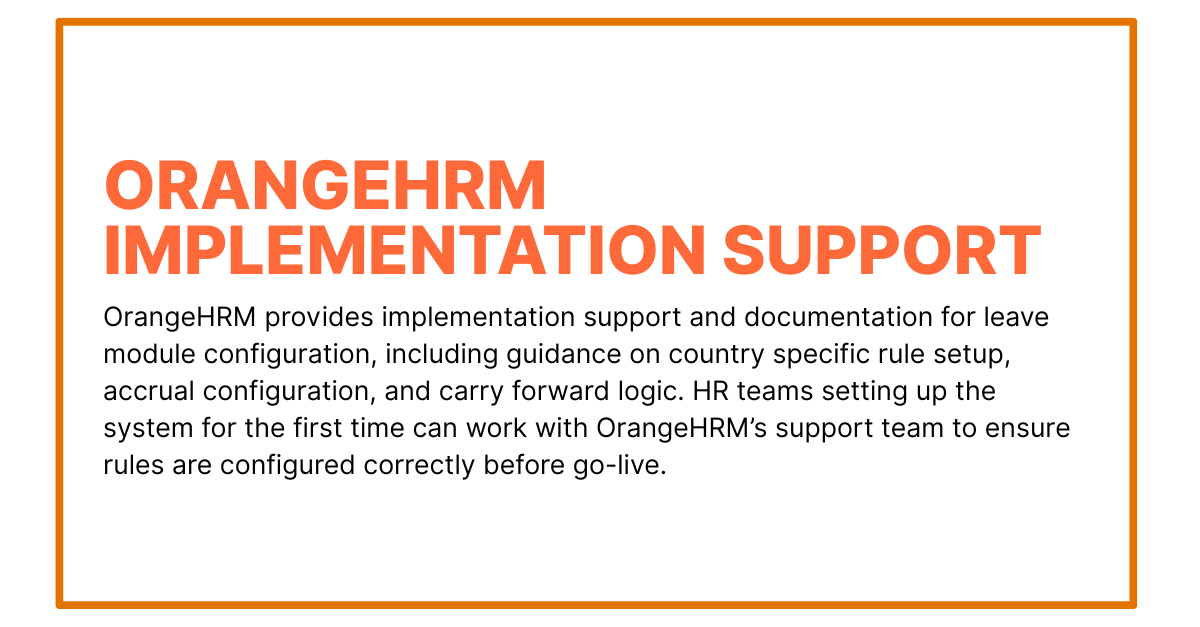
Getting Started: A Practical Framework for Leave Rule Configuration
For HR teams preparing to configure or reconfigure their leave management approach, the following framework provides a practical starting point.
-
Map your leave policy landscape by country. For each country of operation, document: the statutory leave types and minimum entitlements, any company-enhanced entitlements that exceed statutory minimums, the leave period (calendar year, financial year, or hire date-based), accrual frequency and method, carry forward rules, and any special leave types applicable in that jurisdiction.
-
Identify your custom leave types. Beyond statutory requirements, list every leave type your organisation offers globally, including discretionary leave, enhanced parental leave, wellness days, and any role-specific leave categories. For each, define the entitlement method, duration, and any applicable rules.
-
Define your approval workflows. For each leave type, determine the approval structure: single-level (direct manager), multi-level (manager plus HR), or auto-approved. Configure reminder notifications for pending approvals to prevent requests from sitting unactioned.
-
Configure public holiday calendars. Set up each country’s public holiday calendar with annual repeat enabled. Review and update annually, or when legislative changes introduce new public holidays.
-
Validate entitlement calculations before go-live. Before communicating the new system to employees, run a validation exercise: check that a sample of employees in each country have the correct opening balances, that accruals are calculating as expected, and that carry forward rules are behaving correctly at the end of a test leave period.
-
Communicate and train. Brief all managers on the approval workflow and the shift to self-service. Communicate to all employees how to access their leave information, submit requests, and interpret their entitlement breakdown. Reduce the transition period’s friction by being proactive about change management.
Conclusion
Leave management sits at the intersection of compliance, employee experience, and operational efficiency. For organisations operating in a single country, getting it right is important. For multinational organisations, getting it right across every country simultaneously, consistently, automatically, and without a growing team of people managing exceptions, requires infrastructure that most HRMS platforms were not designed to provide.
OrangeHRM’s Leave Rule Engine was built for exactly this challenge. Its combination of country-based configuration, flexible entitlement types, granular accrual and carry forward rules, short-term validity windows, and Bradford Factor monitoring gives HR teams the configurability they need to reflect real-world policy complexity, and the automation they need to apply it without manual overhead.
The organisations that will have the most success with global leave management in the years ahead are those that treat their HRMS leave configuration as a strategic asset, not a back-office setup task. That starts with choosing a platform whose leave rule engine is powerful enough to handle the complexity of the business you are building.
FAQs
-
What is a leave rule engine in HR software?
-
A leave rule engine is the configuration layer within an HRMS leave module that defines how leave entitlements are calculated, accrued, carried forward, and applied. It translates company policy and statutory requirements into automated, consistent system behaviour. A sophisticated leave rule engine, like the one in OrangeHRM, supports multi-country configurations, multiple accrual methods, complex carry forward logic, and custom leave types, all within a single platform.
-
How does OrangeHRM handle leave management for multinational companies?
-
OrangeHRM’s Leave Rule Engine supports country-specific configuration as a core capability. HR administrators can define separate leave rules, accrual schedules, public holiday calendars, and carry forward policies for each country of operation, all within a single platform instance. This means a global HR team can maintain centralised oversight while ensuring that the rules applied to employees in each country accurately reflect local statutory requirements and company policy.
-
What leave types can be configured in OrangeHRM?
-
OrangeHRM supports a wide range of leave types, including annual leave, sick leave, maternity and paternity leave, public holidays, compensatory leave, in-lieu leave, bereavement leave, and fully custom leave categories such as wellness days, study leave, or volunteering leave. Each leave type is configured independently with its own entitlement method, accrual rules, carry forward settings, and approval workflow.
-
What is the Bradford Factor in leave management?
-
The Bradford Factor is an absence management formula that calculates a score for each employee based on the frequency and duration of their absences. Frequent short absences generate a higher Bradford score than an equivalent number of days taken as a single continuous absence, reflecting their greater disruptive impact on team planning and productivity. OrangeHRM allows HR administrators to configure Bradford Factor thresholds, with the system automatically flagging employees who cross defined levels for HR review.
-
Can OrangeHRM integrate leave data with payroll?
-
Yes. OrangeHRM’s leave management module integrates with payroll, ensuring that leave balances and absence records flow directly into payroll calculations. This eliminates the manual data transfer that is a common source of payroll errors in organisations using separate HR and payroll systems. The integration supports accurate calculation of paid leave, unpaid absence deductions, and leave encashment where applicable under company policy.
-
Is OrangeHRM suitable as a best HR software for EU companies?
-
OrangeHRM is well-suited for organisations operating in the EU, where the Working Time Directive establishes binding minimum annual leave entitlements across member states and individual countries layer additional requirements on top. The platform’s ability to configure country-specific leave rules, public holiday calendars, and carry forward policies makes it capable of reflecting the distinct statutory requirements of each EU member state within a unified HRMS. It also supports the GDPR-compliant management of employee leave data.