Why Annual Surveys Miss the Turnover Warning Signs?

Your annual employee engagement survey comes back with a 78% satisfaction score. The executive team is pleased. Then, three months later, five of your top performers hand in their resignations, all citing reasons that were building for months. Sound familiar?
Annual surveys have long been a cornerstone of HR strategy. But in today's fast-moving workplace, they may be giving organizations a false sense of security. By the time the results land on an HR Manager's desk, the warning signs that predict employee turnover have often already passed the point of no return.
This article explores why once-a-year feedback cycles are structurally unable to catch the real-time signals that drive employee attrition, and what forward-thinking HR teams are doing instead. If you rely on annual surveys as your primary employee feedback tool, this is a critical read.
The State of Employee Feedback: Why the Annual Survey Became the Norm
For decades, the annual employee engagement survey was considered best practice. It offered a structured, organization-wide snapshot of morale, culture, and satisfaction. HR teams could benchmark year-over-year, present data to leadership, and tie findings to strategic planning cycles.
The problem is that workplaces have fundamentally changed. Remote and hybrid work, generational shifts in workforce expectations, and the acceleration of career mobility mean employees make decisions faster than ever, and they don't wait for survey season to do it.
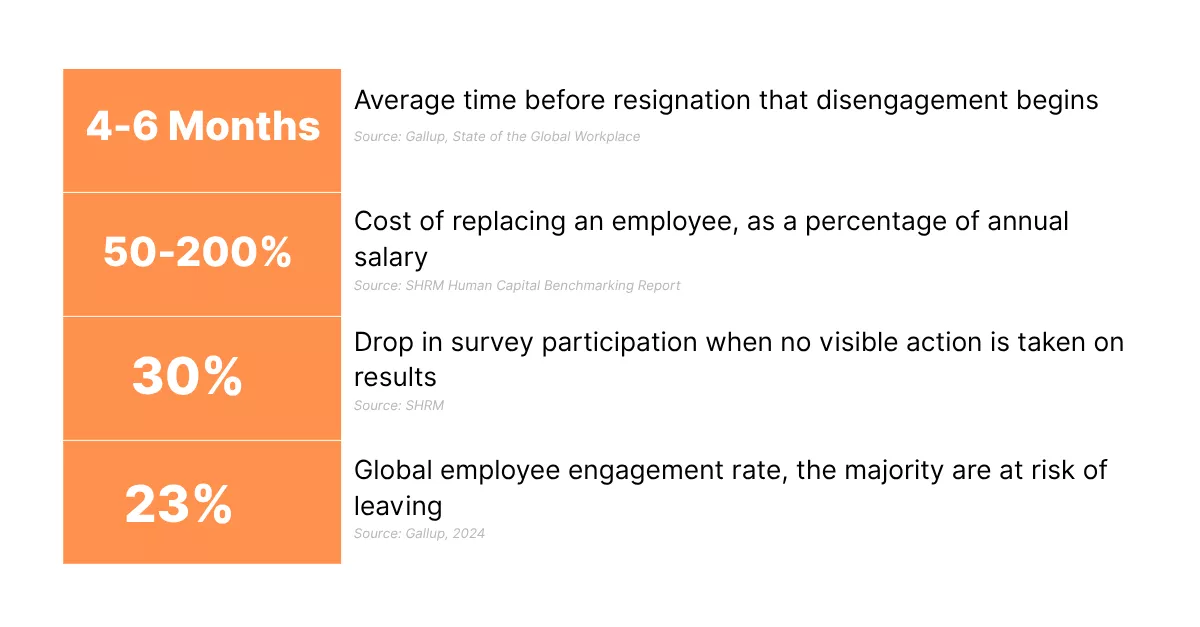
According to Gallup's State of the Global Workplace report, only 23% of employees worldwide are actively engaged at work. The majority are either passively disengaged or actively looking to leave, and most of them won't tell you in an annual survey.
The research is clear: employees who disengage don't typically send a formal signal. They quietly reduce their effort, stop volunteering for new initiatives, and begin exploring other opportunities, all well before they submit a resignation. An annual employee satisfaction survey, conducted once every 12 months, simply cannot detect this progression in time.
A Hypothetical Story: The Team That Looked Fine on Paper
Consider a mid-sized technology services company with around 400 employees. Their annual engagement survey, run each November, returned strong scores across the board: 81% overall satisfaction, high marks for management communication, and positive ratings for career development opportunities.
What the survey didn't capture: between April and September of that same year, two high-performing project leads had quietly started disengaging. One had requested a flexible working arrangement three times; each request was acknowledged but delayed. The other had flagged concerns about workload distribution in a team meeting, received polite acknowledgement, and heard nothing further.
By the time November's survey arrived, both employees had already mentally "checked out." They completed the survey professionally and gave neutral responses, not negative enough to trigger concern, but not honest enough to reflect their actual intent to leave. Both resigned within 60 days of the survey results being published.
This scenario plays out in organizations of every size. The issue isn't that leadership didn't care; it's that the tools in place weren't designed to catch these signals in time.
Why Annual Surveys Miss the Warning Signs: 5 Structural Gaps
1. The Timing Gap: Feedback Is Already Stale
An annual survey captures a moment in time, not a trend. By the time data is collected, analysed, and presented to leadership, three to six months may have passed. For an employee who began disengaging in Q1, a Q4 survey result offers no practical intervention window.
Gallup's research consistently shows that the average employee who plans to leave begins exhibiting disengagement behaviours four to six months before their resignation. An annual cycle guarantees this window is missed.
2. The Recency Bias Problem
Humans naturally recall recent experiences more vividly than older ones. When employees complete an annual survey, their responses are disproportionately shaped by what happened in the past few weeks, not the full preceding year. A positive team event in October can mask six months of frustration that accumulated between January and September.
3. Survey Fatigue and Low Authenticity
When employees know that feedback reaches leadership once a year and that visible change rarely follows, survey cynicism sets in. Participation drops, and those who do participate tend to give socially acceptable rather than honest answers. The result is data that confirms leadership's assumptions rather than challenging them.
According to SHRM, organizations that fail to act visibly on survey results see participation rates drop by up to 30% in subsequent cycles, further eroding the reliability of an already limited tool.
3. No Contextual Data Integration
An employee satisfaction survey exists in isolation. It doesn't connect to attendance patterns, performance data, leave frequency, or internal mobility signals. But employee turnover risk is rarely a single-factor problem; it's a convergence of signals across multiple HR data points.
An employee who has increased sick leave, declined a promotion conversation, and given lower peer review scores over three months is showing a pattern. An annual survey won't connect these dots. HR Management Software with integrated analytics can.
5. No Mechanism for Immediate Action
Even when an annual survey surfaces a problem, say, low scores in a specific department, the pathway from insight to action is slow. Report generation, leadership review, action planning, and implementation can take months. For an employee already at the tipping point, this timeline is simply too long.
Key statistics on the cost of reactive feedback:
What Works Instead: Real-Time Feedback and Continuous Listening
Forward-thinking HR teams are replacing, or supplementing, annual surveys with a layered feedback ecosystem that captures sentiment in real time and connects it to broader workforce data.
Pulse Surveys: Frequent, Lightweight, Actionable
Pulse survey tools send short, targeted questions to employees on a weekly, bi-weekly, or monthly basis. Because they're brief (typically 2–5 questions), completion rates are higher, and responses are more reflective of current experience.
Unlike annual surveys, pulse surveys allow HR teams to detect a drop in team sentiment within weeks, not months, and intervene before disengagement deepens. When integrated with HR survey software, results can be segmented by team, location, tenure, or role level, enabling precise, targeted responses.
360-Degree Feedback: A Fuller Picture
Annual performance reviews that run once a year share the same structural limitation as annual surveys. Introducing 360-degree feedback software creates a more holistic, ongoing view of an employee's experience and relationships at work.
When a team member's peer feedback scores decline across consecutive review cycles, this is a meaningful signal, one that combines with survey data, attendance trends, and performance metrics to create an early warning composite.
Integrated HR Analytics: Connecting the Dots
The most powerful shift HR teams can make is moving from isolated surveys to integrated employee experience platforms. When feedback tools connect to HRMS data, including leave records, performance scores, training completion, and internal mobility history, patterns emerge that no single tool could surface alone.
OrangeHRM's all-in-one HRMS platform is designed to centralise these data streams, giving HR Managers a unified view of the workforce rather than siloed snapshots. With integrated HR analytics dashboards, teams can track engagement indicators alongside operational data, enabling proactive rather than reactive talent management.
Annual Surveys vs. Continuous Listening: A Direct Comparison
|
Dimension |
Annual Surveys vs. Continuous Learning Approach |
|
Frequency |
Once per year vs. Weekly / Monthly / On-demand |
|
Data Freshness |
Stale (3–12 months old) vs. Real-time or near-real-time |
|
Turnover Warning |
Missed in most cases vs. Early signals detected within weeks |
|
Employee Trust |
Cynicism common after years of inaction vs. Higher trust when feedback loops are visible |
|
Integration |
Standalone tool vs. Connected to HRMS, performance, and leave data |
|
Action Speed |
Months from insight to action vs. Days to weeks |
|
Cost of Inaction |
High resignations occur before intervention, vs. significantly reduced with early intervention |
The Challenges of Moving to Continuous Listening
It would be misleading to suggest that replacing annual surveys with real-time feedback is straightforward. There are legitimate challenges that HR teams should anticipate.
Change Management and Adoption
Employees who are accustomed to one annual survey may be sceptical about more frequent check-ins. Without clear communication about why the approach is changing, and visible evidence that feedback leads to action, increased frequency can actually increase cynicism rather than reduce it.
The solution is to make the feedback loop transparent. When a pulse survey identifies a concern and a change is made in response, communicate that connection explicitly. "You told us X; here's what we did" is one of the most powerful trust-building statements an HR team can make.
Data Overload Without the Right Tools
More frequent surveys generate more data, and without the right HR Management Software to aggregate, analyse, and surface insights, this data becomes noise rather than signal. Organizations that layer pulse surveys on top of manual tracking processes often find the volume unmanageable.
This is where investing in a capable HRMS Software platform pays dividends. Automated reporting, trend visualisation, and alert-based dashboards remove the manual burden from HR teams while ensuring critical signals are never buried.
Privacy and Psychological Safety
More frequent data collection raises legitimate questions about employee privacy, particularly in smaller teams where anonymity is harder to maintain. HR teams must design feedback architectures that genuinely protect respondents, and communicate this clearly.
Employees who fear identification will either avoid surveys or provide socially acceptable rather than honest responses, recreating the same problem that made annual surveys unreliable in the first place.
How to Build a More Effective Employee Feedback Strategy: 6 Steps
-
Step 1: Audit your current feedback architecture
-
Map every existing touchpoint where you collect employee sentiment data, surveys, exit interviews, performance reviews, and informal check-ins. Identify the gaps, the lag time, and where data currently sits in silos.
-
-
Step 2: Define what turnover warning signals look like in your organization
-
Work with your leadership team to identify the behavioural and data indicators that have historically preceded resignations. Common signals include increased absenteeism, declining performance review scores, reduced engagement in team communications, and unused leave accumulation.
-
-
Step 3: Introduce pulse surveys alongside, not instead of, annual surveys initially
-
Start with a bi-monthly pulse cadence covering 3–4 questions on key engagement themes. Use this to build familiarity, demonstrate responsiveness, and establish a data baseline before making larger structural changes.
-
-
Step 4: Invest in HR software that integrates feedback with operational data
-
The power of continuous listening is multiplied when feedback data is connected to attendance, performance, and leave records. Look for the best HRMS platform that consolidates these data streams and provides analytics dashboards accessible to HR Managers without requiring technical expertise.
-
-
Step 5: Close the feedback loop visibly and consistently
-
Every feedback initiative must have a visible output. Whether it's a policy change, a team-level conversation, or a leadership update, employees need to see that their input changes something, or they will stop providing it honestly.
-
-
Step 6: Train managers to act on micro-signals
-
HR strategy is only as effective as the managers who execute it. Train line managers to recognise early disengagement signals in their direct reports, a shift in communication style, withdrawal from team activities, or repeated requests for flexibility that go unaddressed. Equip them with HR tools that surface these patterns proactively.
-
Is Your Feedback Strategy Catching Turnover Risks Early? A Quick Checklist
Score your current approach, tick all that apply:
-
☐ We collect employee feedback more frequently than once per year
-
☐ Our feedback data is connected to HRMS, performance, and attendance records
-
☐ Managers receive alerts or reports when team sentiment shifts significantly
-
☐ We visibly communicate actions taken in response to employee feedback
-
☐ Our HR software flags employees showing multiple disengagement indicators
Exit interview data feeds back into our pulse survey design and risk models
If you ticked fewer than 3: your feedback strategy has significant gaps that are likely contributing to avoidable turnover.
Conclusion
Annual employee surveys were built for a slower, more stable world of work. In today's environment, where talent is mobile, expectations are higher, and the cost of turnover continues to climb, they are no longer sufficient as a standalone retention tool.
The organizations that are winning on retention aren't waiting for November's survey results to discover that their best people are thinking about leaving. They're listening continuously, acting visibly, and using integrated HR technology to connect the dots between engagement signals and operational data.
Shifting from reactive to proactive feedback isn't a wholesale transformation; it's a series of deliberate steps: introducing pulse surveys, integrating your feedback tools with your HRMS, training managers to act on early signals, and closing the feedback loop so employees see their voices driving real change.
OrangeHRM's all-in-one HR management software is built to support exactly this kind of intelligent, connected people strategy. From centralised employee data to customisable survey and analytics tools, it gives HR teams what they need to move from annual snapshots to real-time insight.
Ready to build a smarter employee feedback strategy? Book a free OrangeHRM demo today!
FAQs
-
Why are annual employee engagement surveys not enough to prevent turnover?
-
Annual surveys capture a single data point per year, but employee disengagement is a process that unfolds over months. Research from Gallup shows that employees typically begin disengaging four to six months before they resign, a window that an annual survey almost always misses. Without more frequent feedback mechanisms, HR teams are responding to problems long after the tipping point has passed.
-
-
What is a pulse survey, and how does it differ from an annual survey?
-
A pulse survey is a short, frequent check-in, typically 2–5 questions sent weekly, bi-weekly, or monthly, designed to track employee sentiment in real time. Unlike annual surveys, which provide a broad retrospective snapshot, pulse surveys surface emerging concerns quickly and allow HR teams to intervene before disengagement escalates into resignation.
-
-
How does HR software help identify turnover risk early?
-
Modern HR Management Software integrates data from multiple sources, survey results, attendance records, performance scores, and leave patterns, to create a composite view of each employee's engagement health. When multiple risk indicators converge (for example, increased sick leave combined with declining peer review scores and neutral survey responses), the system can flag this for HR review before the employee reaches the point of active job searching.
-
-
Can small businesses use continuous listening tools effectively?
-
Absolutely. In fact, smaller organizations often benefit most from continuous listening tools because the cost of losing even one or two key employees is proportionally higher. Many modern HRMS platforms, including free and open-source options, include pulse survey functionality and basic sentiment analytics that are accessible without a large HR technology budget. The key is consistency: small, frequent feedback actions outperform elaborate annual processes in detecting and addressing turnover risk.
-
-
What questions should be included in a pulse survey focused on retention?
-
Effective retention-focused pulse surveys ask directly about the factors most predictive of turnover: clarity of role expectations, quality of the manager relationship, confidence in career growth, sense of belonging, and workload sustainability. Rotating 2–3 of these themes across a monthly cadence, rather than asking the same questions repeatedly, keeps responses fresh and prevents survey fatigue.
-